 THE MAGGIE MARSHALL TEAMLet’s connect
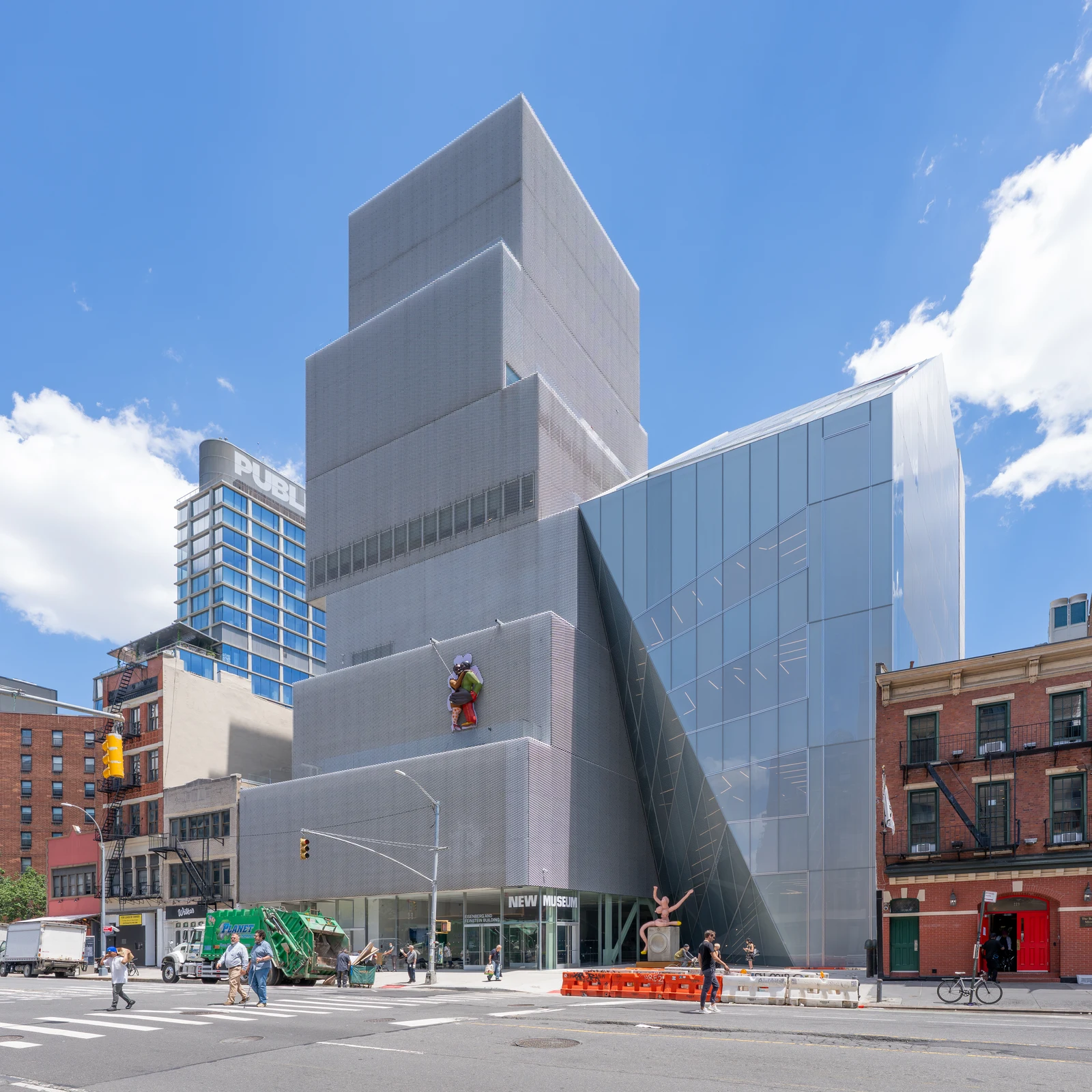
Silver boxes climb into a blue sky; beside them, a plane of glass folds toward the pavement. In Ajay Suresh’s June photograph of the expanded New Museum, the two buildings make an unusually expressive pair. One rises in offset steps. The other introduces a long diagonal. Red brick, fire escapes and a garbage truck keep the composition firmly on the Bowery. 1
The museum reopened on March 21, 2026, with a 60,000-square-foot addition. 2 This autumn, the building and the program make an especially apt pair: the architecture offers a new way to look at the neighborhood, while an exhibition turns the neighborhood itself into the subject. Leave enough time to look up, double back and eventually sit down.
Two buildings in conversation
SANAA’s original building opened in 2007. The addition is by OMA’s Shohei Shigematsu and Rem Koolhaas, working with Cooper Robertson. Its laminated-glass facade incorporates metal mesh, picking up a material language from its neighbor while allowing greater transparency. 2 In the photograph, that family resemblance is clear: the surfaces share a silvery register, even as their outlines pull in different directions.
The connection becomes practical inside. Gallery floors align on the second, third and fourth levels, allowing movement between the buildings. A west-facing atrium stair links the expansion’s levels and provides views of the surrounding neighborhood. Facade consultant Front describes a building designed to make visitors’ movement partially visible through its glass and mesh. 3 The route between artworks becomes something to notice in its own right.
Front’s scope included more than twenty facade and roof systems, from inclined and vertical curtain walls to skylights, with laminated metal mesh recurring across them. 3 That complexity invites a closer look at a seemingly simple surface. Follow an edge upward, then watch how the building changes direction. The joints and folds help explain the shape.
Carry those connections through a visit. Look for the moment the route crosses from one building to the other, and notice where a neighborhood view interrupts the concentration of a gallery. A museum asks for sustained attention, but the pause between artworks can be revealing, too: the city appears through the same skin that shapes the building from outside.
The museum also offers building audio tours for adults and children through its Bloomberg Connects digital guide, with contributions from lead architect Shohei Shigematsu and hosts Chloë Sevigny and Julio Torres. 2 It is an easy way to give the architecture a share of the attention before an exhibition takes over. Open the guide while planning the visit and bring headphones.
Art also occupies the spaces around that route. The museum currently lists Sarah Lucas’s VENUS VICTORIA for the plaza, Tschabalala Self’s Art Lovers on the facade and Klára Hosnedlová’s Shelter in the atrium stair as long-term commissions. 4 Keep those three locations in mind: an approach, an exterior wall and a stair can each become part of the visit.
The street becomes the subject
On view through January 31, 2027, The Bowery: Devil’s Mile gives the afternoon its local thread. 4 The exhibition brings together archival material, historical objects and artworks to trace the street’s changing lives. Its range includes an 1830s hand-pump fire engine and Jacob Riis photographs, alongside work by artists including Nan Goldin, Keith Haring and Eva Hesse. 5
That breadth makes a promising companion to the new construction. The exhibition’s account moves through the Bowery’s histories of entertainment and artistic experimentation, drawing on the museum’s own archive and oral-history research. 5 It offers a reason to take the street seriously at several scales: the individual image, the room where something happened, the address that acquired another use.
Choose an object or photograph that holds your attention and give it a few extra minutes. Read its label closely, then consider what it asks you to notice about the street outside. An afternoon can have a center without becoming a checklist; one carefully examined detail offers a way back into a history too large to absorb all at once.
Leave time to stay
Oberon, the restaurant and bar inside the expansion, offers a natural pause. The museum identifies Ali Ghriskey as executive chef and names ongoing collaborations with Ian Cheng, Minjae Kim and Laurie Anderson across the restaurant’s design, atmosphere and programming. 6 OMA describes the design as an effort to give the restaurant an identity of its own while keeping it connected to the museum. 7 Check its menu and reservations before building lunch or dinner into the plan.
The practical details, checked October 20: the New Museum is at 235 Bowery. It opens at 11 a.m. Tuesday through Sunday, closing at 6 p.m. except on Thursdays, when it stays open until 9 p.m. Mondays are closed. Adult admission is $28; visitors 18 and under enter free. 8
Thursday’s 7–9 p.m. admission is pay what you wish, with tickets reserved online in advance. A limited number may be available onsite, but the museum says those are not guaranteed. 8 For a daylight visit, leave a little room afterward for the Bowery itself. The silver boxes and folded glass will still be there when you emerge, newly familiar against the smaller brick facades. After an afternoon spent looking, the walk can be part of the pleasure.